
Good communication skills are one of the most valuable capabilities in today’s workplace.
Whether you’re working in an office, remotely, or in a hybrid environment, the ability to communicate clearly can affect everything from teamwork and productivity to leadership and career growth.
Modern workplaces are also changing rapidly. Employees now communicate through emails, video calls, messaging platforms, and digital collaboration tools every day.
Because of this, professionals need far more than basic speaking skills to succeed. They must know how to listen actively, write clearly, provide professional feedback, and communicate effectively with people from diverse backgrounds and cultures.
This article explores why communication abilities are critical, the key workplace communication skills professionals need today, and how communication skills training, such as the MANCOSA skillME Communication in the Workplace programme, can help individuals strengthen these skills.
Why are good communication skills more essential than ever?
Good communication has always mattered in business, but today it is more important than ever. Modern workplaces are now built around:
- Remote teams
- Hybrid schedules
- Video meetings
- Instant messaging apps
- And constant digital communication
The growing impact of remote work on communication skills means professionals can no longer rely only on face-to-face conversations to build trust and work effectively together.
Instead, they must know how to communicate clearly across multiple platforms and with people from different backgrounds and locations.
The real cost of miscommunication
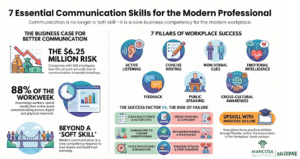
According to Grammarly’s 2024 State of Business Communication Report, knowledge workers now spend 88% of their workweek communicating across channels like email, messaging apps, and meetings.
As such, the consequences of poor workplace communication can be extremely costly.
Misunderstandings often lead to missed deadlines, lower productivity, employee frustration, and even staff turnover. More research from Grammarly and The Harris Poll found that companies with 500 employees can lose $6.25 million every year due to communication problems.
This highlights the importance of learning this high-value skill.
From soft skill to core competency
As workplaces become more digital and globally connected, communication is no longer just a “soft skill.” It is now a core business skill.
Professionals who focus on advancing communication skills for career success are often better equipped to lead teams, collaborate effectively, and adapt to the changing world of work.
7 Key communication skills you need to succeed in today’s market
Here are seven communication abilities that matter most in today’s workplace — both for individuals and companies alike:
1. Active listening
Communication starts with listening. Active listening means fully focusing on what someone is saying instead of simply waiting for your turn to speak. This skill helps reduce misunderstandings and improve collaboration.
That’s why it’s important that during meetings and conversations, you summarise what the speaker said before responding. This confirms understanding and shows respect.
2. Clear and concise writing
Modern workplaces rely heavily on emails, chats, reports, and project management tools. As a result, long, confusing messages often slow teams down and lead to unnecessary mistakes.
That’s why learning to communicate clearly and concisely in writing is one of the most essential communication skills for job success today.
To illustrate this, imagine:
- Receiving a five-paragraph email with the main instruction hidden at the bottom.
- Now compare that to a short message with bullet points and a clear action step.
The latter is much better for speedy, effective communication.
3. Non-verbal communication
It’s also not just about what you say, but also how you present yourself.
Body language, facial expressions, tone of voice, and eye contact still matter greatly, especially during video calls. A confident tone and positive facial expressions can make conversations feel more engaging and professional.
Even in written communication, tone matters. A short message can sometimes sound rude when that was never the intention.
4. Emotional intelligence and empathy
Emotional intelligence helps people understand emotions, manage conflict, and communicate more thoughtfully.
Employees with high emotional intelligence are often better leaders and team players. This can lead to great career success for the individual and a better company culture for the employer.
5. Giving and receiving feedback
Feedback helps teams improve, but it should be respectful and specific. Focus on behaviours and outcomes instead of attacking someone personally.
For example, instead of saying, “You are disorganised,” say, “Submitting the report late affected the client’s deadline.”
6. Presentation and public speaking skills
Whether leading a Zoom meeting or presenting ideas to clients, strong presentation skills help professionals communicate with confidence and clarity. The more clearly you explain ideas, the easier it becomes to influence decisions and build trust.
7. Cross-cultural communication
Today’s workplaces are more global than ever. Employees often work with clients, colleagues, and teams from different cultures and backgrounds. Understanding different communication styles can prevent confusion and improve teamwork.
The benefits of doing a business communication course with MANCOSA skillME
If you’re wondering how to improve communication skills at work, structured training can make a major difference.
Courses such as the MANCOSA skillME Communication in the Workplace short course help professionals strengthen practical business communication skills that can improve teamwork, leadership, and long-term career growth.
Some of the main benefits of pursuing such a course include:
- Flexible online learning allows students to study at their own pace while balancing work and personal responsibilities.
- Interactive content, industry-relevant learning material, and a certificate upon completion.
- Programmes are also affordable and fully online, making them accessible for professionals who want to upskill without committing to a full qualification.
Professionals wanting to strengthen their workplace communication and companies wanting to upskill their employees can explore the MANCOSA skillME short courses platform.
We also offer related programmes such as:
FAQs
What are communication skills for workplace success?
Communication abilities help professionals share ideas clearly and work effectively with others.
These skills include verbal communication, written communication, active listening, presentation skills, and cross-cultural awareness. In today’s workplace, strong communication is considered a core business skill rather than simply a soft skill.
What are 7 effective communication skills in the workplace?
Seven important workplace communication abilities include:
- Active listening
- Concise writing
- Non-verbal communication
- Emotional intelligence
- Giving feedback
- Presentation skills
- And cross-cultural communication
These skills help employees collaborate better by reducing misunderstandings. Ultimately, this also helps build stronger professional relationships and a better company culture.
How can I improve my communication skills at work?
You can improve your skills at work by practising active listening, improving your writing clarity, participating in presentations, and learning how to give constructive feedback.
Structured training programmes, such as the MANCOSA skillME Communication in the Workplace short course, can also help professionals strengthen workplace communication and support long-term career growth.
Register for a MANCOSA skillME communication skills course
As businesses become more digital, global, and fast-paced, professionals need to develop stronger communication skills.
From active listening and clear writing to emotional intelligence and presentation skills, these abilities play a major role in professional success across every industry.
They also help reduce misunderstandings and create more productive teams — ultimately helping companies grow.
The good news is that communication is a skill that can be developed.
Short online programmes, such as the MANCOSA skillME Communication in the Workplace course, provide practical tools and flexible learning opportunities to help professionals strengthen essential workplace skills and stay competitive in the modern job market.
Popular Searches:-
Short Courses | Project Management Course | Logistics Courses | Supply Chain Management Course | Digital Marketing Courses | Data Analytics Courses | Finance Manager Course | Health Promotion Officer | Leaders Skills | Good Clinical Practice | Cyber Security Courses In South Africa | Short IT Course | Logistics Management Courses | Communication Courses | Artificial Intelligence Course | Gcp Certification | Design Course | Work Readiness Program | Customer Service Course | English Course | Infection Control Courses | Ethics Course | Women in Leadership Course | Corporate Training | Fintech Courses | Conflict Management Course | Psychiatry Courses | Blockchain Course