

Trying to study while working full-time can feel overwhelming. Your days are already filled with meetings, deadlines, commuting, and personal responsibilities. So finding time to focus on a short course can seem almost impossible.
But here’s the good news: you don’t need more time, you need a better plan.
With the right study timetable, you can fit learning into your schedule without feeling stressed or burned out.
This is especially important as more South African companies are investing in online short courses, like MANCOSA skillME, to help employees build new skills and stay competitive.
In this guide, you’ll learn how to create a practical study timetable that works around your full-time job so you can succeed in your course and still maintain a healthy work-life balance.
The clock’s ticking: why time management is your superpower
If you’re working full-time and studying at the same time, your schedule can feel a little chaotic. That’s why having a clear study timetable isn’t just helpful, it’s essential.
Research shows that time management plays a major role in academic success. According to a study published in PubMed, students who plan their study time are more likely to complete tasks on time and perform better overall.
Here are some of the main benefits of having a timetable:
- A solid timetable helps you stay on track. Instead of cramming assignments at the last minute, you create small, focused study sessions that fit into your week. This reduces stress, improves your understanding, and helps you avoid burnout.
- It also helps you find your “study sweet spot.” Maybe you focus best early in the morning before work, or late at night when everything is quiet. Some people use weekends for longer study sessions. When you plan your time around your energy levels, you learn faster and more effectively.
- And if your company is paying for your course, a timetable shows professionalism. It shows you take the opportunity seriously and are committed to developing your skills, which can open doors to future opportunities.
- Most importantly, a timetable protects your balance. It gives you time to study, work, and still rest. And that balance is what helps you succeed long-term.
5 Tips for putting together your personalised study timetable
The key to building an achievable study schedule is to focus on what actually fits your real life, not an ideal version of it. These five practical tips will help you create a timetable that is realistic, flexible, and actually works.
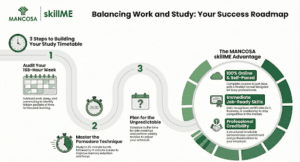
1. Audit your time realistically (The 168-hour rule)
Start by understanding where your time is going. You have 168 hours in a week. Subtract your working hours, commuting, sleep (experts like the Sleep Foundation recommend 7–9 hours per night), and personal responsibilities.
What’s left is your available part-time study time.
Research from Harvard Business School shows that time-mapping helps people identify hidden pockets of free time. Even small gaps (like 30 minutes before work or during lunch) can be used for focused learning. The goal is to plan based on reality, not guesswork.
2. Use the Pomodoro Technique for better focus
Studying for long hours without breaks can lead to burnout and poor concentration. Instead, try the Pomodoro Technique:
- 25 minutes of focused study
- 5-minute break
Studies in cognitive psychology show that shorter, focused sessions improve attention and memory retention. For busy professionals, this method is perfect. You can fit in a few “Pomodoros” during your lunch break or after work without feeling overwhelmed.
3. Schedule buffer time and review sessions
Life is unpredictable, especially in a busy work environment. Meetings run late, traffic happens, and some topics take longer to understand.
That’s why you should:
- Add 10–15 minutes of buffer time between tasks.
- Schedule a weekly review session.
According to research from the American Psychological Association, reviewing information regularly and over a longer period improves long-term memory and reduces stress before exams or deadlines. A weekly review helps you stay on track and avoid last-minute cramming.
4. Create a dedicated study space
Where you study matters just as much as when you study. A quiet, organised space helps your brain switch into “focus mode.”
Clutter and distractions can reduce your ability to focus and process information.
Your study space doesn’t have to be fancy. It can be a desk at home or a quiet corner in a library. The important thing is consistency. When you sit in that space, your brain knows it’s time to learn.
5. Stay flexible and review your timetable weekly
Your timetable should work for you, not the other way around. After your first week, take time to reflect:
- What worked well?
- What didn’t?
Maybe your evening study sessions are too tiring, or your weekend plans are too ambitious. That’s okay. Adjust your schedule.
Flexibility is key to building sustainable habits. A weekly check-in (for example, every Sunday evening) helps you stay aligned with your energy levels, work demands, and personal life.
Why studying an online short course with MANCOSA skillME is a smart move
If you’re looking to grow your skills while working full-time, studying with MANCOSA skillME is a smart and practical choice.
MANCOSA skillME offers a wide range of short online courses across fields like business, IT, data analytics, healthcare, and leadership. These courses are designed to give you real, job-ready skills that you can apply immediately in your workplace.
One of the biggest advantages is flexibility. All courses are 100% online and self-paced, meaning you can study anytime, anywhere, which is perfect for busy professionals balancing work and personal commitments.
Some courses can even be completed in just a few days, allowing you to upskill quickly without long-term study pressure.
MANCOSA skillME courses are also designed with affordability and accessibility in mind. With short course formats, they make professional development more achievable for both individuals and companies investing in employee training.
You’ll also benefit from expert-led instruction, digital learning resources, and ongoing academic support, ensuring you’re never learning alone. Plus, you receive a certificate upon completion, which you can share with employers and add to your professional profile.
Whether you want to improve your current skills, switch careers, or grow within your company, MANCOSA skillME gives you a flexible and effective way to reach your goals.
FAQs
Q. What are the 5 disadvantages of online learning?
Online courses offer flexibility, but there are a few challenges to keep in mind.
These include:
- The need for strong self-discipline
- Possible feelings of isolation
- Reliance on stable internet access
- Occasional technical issues
- Less face-to-face interaction with lecturers or classmates
For full-time workers, the biggest challenge is usually staying consistent. That’s why having a structured study timetable is so important.
Q. What is the biggest problem with online school?
The biggest problem for many students taking an online course is procrastination. Without a fixed class schedule, it’s easy to delay studying or rush through assignments at the last minute.
This can lead to stress and poor results. A clear and realistic study timetable helps solve this problem. It gives you structure, keeps you accountable, and helps you balance your work and study responsibilities more effectively.
Q. How do I motivate myself to study after work?
Studying after a full workday can feel difficult, but small steps make a big difference. Start with short sessions, like 25 minutes, using the Pomodoro Technique, to make studying feel manageable.
Create a quiet, distraction-free study space and plan your sessions at times when you still have some energy.
It also helps to remind yourself why you started, whether it’s for career growth, better opportunities, or to build confidence. Motivation often builds once you take action.
Q. Is a study timetable necessary for a short course?
Yes, absolutely. Even though an online short course is flexible, a study timetable is essential — especially if you’re working full-time. It helps you set aside dedicated study time, stay on track with deadlines, and avoid last-minute stress.
A good timetable also protects your work-life balance by making sure you schedule time for rest. In short, it’s the key to completing your course successfully without feeling overwhelmed.
Register for a MANCOSA skillME online short course
With the right study timetable and a flexible learning option, you can successfully complete a short course and move closer to your career goals.
A MANCOSA skillME online short course gives you flexibility, practical skills, and a structured learning experience that fits into your busy schedule.
Explore the wide range of short courses available. From business and leadership to IT and healthcare, there’s a course that can help you grow professionally and stay competitive in today’s job market. Browse and register here.