
Projects are everywhere. From launching a new app to building roads, upgrading IT systems, or improving business processes, organisations rely on projects to grow and stay competitive.
Behind every successful project is a skilled project manager who keeps everything on track. But what does a project manager do, and why is this role becoming so important in South Africa?
As businesses face tighter deadlines, limited budgets, and increasing complexity, the demand for skilled project managers continues to grow. Many companies invest in employee development through short, practical training rather than long academic programmes.
This is why B2B training for project management courses has become so popular across industries.
In this guide, you’ll learn what a project manager does, the key functions of the role, and how short project management courses, such as those offered by MANCOSA skillME, can help you build practical, job-ready project management skills.
Whether you’re exploring a new career or looking to upskill your team, this article breaks it all down in a simple, easy-to-understand way.
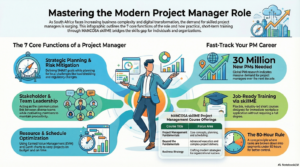
7 Key functions of a project manager
Project management is one of the fastest-growing career paths in the world — and South Africa is no exception.
According to global research by the Project Management Institute (PMI), employers will need 30 million new project managers over the next decade to keep up with business growth, digital transformation, and infrastructure development.
In South Africa, this demand is being driven by:
- Large-scale construction projects
- IT and digital upgrades
- Renewable energy initiatives
- And business process improvements across industries
Because of this, many organisations are no longer waiting for individuals to upskill on their own. Instead, companies are actively investing in B2B training for project management courses to strengthen their internal teams and improve delivery outcomes.
So, what are the duties of a project manager in a company today?
Below are the seven key functions of a project manager in South Africa:
1. Strategic planning and goal definition
A project manager turns a big business idea into a clear, workable plan. This includes:
- Defining the project scope
- Setting clear goals
- And deciding what success looks like
Most project managers use SMART goals (Specific, Measurable, Achievable, Relevant, Time-bound) to guide this process.
In South Africa, planning may also include aligning projects with transformation goals, compliance requirements, or long-term economic objectives.
2. Stakeholder management and communication
Project managers are the main link between teams, managers, suppliers, and clients. Clear communication is critical, especially in diverse workplaces with different cultures, roles, and levels of seniority.
This function includes:
- Running meetings
- Sharing progress updates
- Managing expectations
- And resolving conflicts before they slow the project down
3. Risk management and contingency planning
Every project has risks. In South Africa, these may include load shedding, supplier delays, or regulatory changes. A good project manager identifies risks early, plans for them, and puts backup solutions in place.
For example, if power outages are likely, the project manager may schedule critical work around power availability or arrange alternative resources.
4. Team leadership and motivation
Project managers lead people, not just tasks. They assign responsibilities, track performance, and make sure team members have what they need to succeed.
Motivation, feedback, and support play a big role in maintaining high productivity and strong morale. This is a core part of the project management team roles and functions.
5. Budget and resource allocation
Managing money is a major responsibility. Project managers:
- Estimate costs
- Track spending
- And ensure resources are used efficiently
This helps prevent budget overruns and keeps projects financially viable.
Expert tip: Many South African organisations see Earned Value Management (EVM) as extremely useful because it gives clear visibility into cost and schedule performance.
6. Scheduling and time management
Project managers create timelines that show what needs to be done and when. Tools like Gantt charts help track deadlines, dependencies, and milestones. Strong scheduling ensures projects are delivered on time and remain competitive in fast-moving markets.
7. Quality assurance and continuous improvement
Finally, project managers make sure the work meets quality standards. They review deliverables, ensure compliance, and capture lessons learned to improve future projects. Over time, this leads to better systems and stronger organisational performance.
As you can see, these key functions are critical for success as a manager, making learning key project management skills essential.
Why a MANCOSA skillME project management course is the way to go
If you want to build strong project manager skills and take care of responsibilities that employers value, studying a MANCOSA skillME project management fundamentals course or beyond the fundamentals course is a smart choice.
Whether you’re an individual wanting to grow your career or a company looking to invest in team training, learning these skills will help.
Many South African organisations are choosing B2B training for project management courses, such as those offered by skillME. These programmes are practical, flexible, and directly focused on workplace needs.
What is MANCOSA skillME?
MANCOSA’s skillME platform offers a range of short online courses designed to quickly and effectively boost skills.
These short learning programmes are created by industry professionals and backed by MANCOSA’s academic expertise, meaning you learn workplace-relevant skills you can use immediately.
Many companies prefer these kinds of short courses for staff training because they deliver impact without long leave from work.
Have a look at MANCOSA skillME’s project management and aligned business courses:
- Project Management Fundamentals
- Project Management: Beyond the Fundamentals
- Business Strategy: Crafting and Executing Modern Strategies for Success
FAQs
Can I be a project manager without a degree?
Yes, you can become a project manager without a formal degree. Many people start in junior or support roles and build experience over time. What matters most is your ability to plan, communicate, solve problems, and lead people.
Short courses are a popular entry point because they teach practical skills fast. For example, programmes offered through MANCOSA skillME are designed for working professionals and companies that want to upskill employees without requiring a full project management certification.
These courses help you understand real workplace expectations and build confidence in managing projects.
How long does it take to learn project management?
You can learn the basics of project management in a short time. Introductory courses can be completed in a few hours or weeks, depending on the format. This is enough to understand core concepts like planning, scheduling, risk management, and teamwork.
However, becoming a strong project manager takes ongoing practice. Many professionals continue learning on the job while completing short courses or additional training as they grow into more senior roles.
What is the 80-hour rule in project management?
The 80-hour rule suggests that no task should take longer than 80 hours without being broken into smaller parts. This helps project managers track progress more easily, spot problems early, and keep teams motivated.
Smaller tasks are easier to manage, estimate, and adjust — leading to better control over time, cost, and quality.
Register for a MANCOSA skillME project management course
Project managers play a very important role in helping organisations turn ideas into results. From planning and budgeting to leading teams and managing risks, their work keeps projects moving forward and businesses growing.
As demand for these skills increases in South Africa, more companies are choosing practical, short learning options to upskill their teams quickly and effectively.
A strong foundation in project management doesn’t require a long-term degree right away. Short project management courses can help you understand the role, build confidence, and apply what you learn immediately in the workplace. Whether you’re just starting with project management or looking to strengthen your organisation’s project delivery, courses offered through MANCOSA skillME provide a flexible, affordable, and practical way to build real-world project management skills.