
Healthcare professionals play a vital role in providing safe, effective care. But as technology advances, patient needs change, and healthcare practices evolve, the skills needed to succeed are changing too.
Continuous learning can help healthcare workers keep their knowledge current and develop practical skills that support both patient care and career growth.
The good news is that this doesn’t always require committing to another degree or lengthy qualification. Short online healthcare courses from MANCOSA skillME offer a flexible way to develop specific, career-relevant skills while continuing to work.
In this guide, we explore three top short courses for healthcare professionals and how they can support your development in today’s healthcare landscape.
3 Essential short courses for healthcare workers today
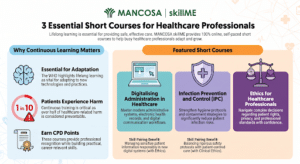
Healthcare is constantly evolving. New technology, changing patient needs, emerging health risks, and updated safety standards mean healthcare professionals need to keep learning throughout their careers.
In fact, the World Health Organization (WHO) highlights lifelong learning as essential for helping healthcare workers adapt to new technologies, emerging diseases, and changing healthcare practices.
Continuous learning can also support career progression while strengthening healthcare systems and patient outcomes.
Short courses offer a flexible way to build these skills without stepping away from your career for several years. For busy professionals, the benefits of online healthcare short courses for career advancement include being able to develop targeted skills while continuing to work.
Here are three valuable options to consider:
1. Digitalising Administration in Healthcare: Modern Practices
Digital technology is becoming a bigger part of healthcare, from electronic health records to digital communication.
However, technology is only effective when healthcare workers know how to use it properly. The WHO notes that health workers need the right digital skills and competencies to use digital tools effectively.
A course in digital healthcare administration can help professionals understand modern administrative systems and improve the way information and workflows are managed.
These skills can be particularly useful for:
- Healthcare administrators
- Practice managers
- Nurses moving into management
- And other professionals involved in day-to-day healthcare operations
2. Infection Prevention and Control for Healthcare
Infection prevention and control (IPC) remains one of the most important areas of healthcare training.
Patients in low- and middle-income countries can face up to a 20 times higher risk of acquiring an infection during healthcare delivery than patients in high-income countries.
IPC training can strengthen your understanding of hygiene protocols, infection risks, containment strategies, and safer healthcare practices.
It’s particularly relevant when looking for short healthcare courses for nurses in South Africa, as nurses work closely with patients across a wide range of clinical settings.
3. Ethics for Healthcare Professionals
Healthcare professionals regularly face decisions involving patient rights, privacy, consent, confidentiality, and professional responsibilities.
Ethics training can help you approach these situations with greater confidence and make decisions that balance professional standards with patient-centred care.
This matters because patient safety remains a global challenge.
Around 1 in 10 patients experience harm in healthcare, with more than half of this harm considered preventable.
Understanding how to improve patient care through continuous healthcare training can therefore go far beyond career development. It can influence the quality and safety of care you provide.
Pro tip: Consider “stacking” complementary skills rather than studying topics in isolation. For example, combining digital healthcare knowledge with ethics training could help you better understand both how to use new systems and how to manage sensitive patient information responsibly.
Where MANCOSA skillME online short courses come in
Finding time to develop new skills can be challenging when you already work in a demanding healthcare environment. This is where MANCOSA skillME’s online healthcare short courses can help.
The courses are delivered 100% online and are self-paced, making it easier to fit further learning around your work and personal commitments.
MANCOSA skillME also offers cost-effective tuition, flexible payment options, student support, and certificates upon completion.
Healthcare professionals can choose courses based on the skills they want to develop. Options include:
- Digitalising Administration in Healthcare: Modern Practices
- Infection Prevention and Control for Healthcare
- Ethics for Healthcare Professionals
These courses also offer CPD points, making them useful for professionals who want to continue learning while building practical, career-relevant skills.
Whether you want to strengthen patient care, improve administrative processes, or expand your professional knowledge, short online courses provide a flexible way to keep your skills current without putting your career on hold.
FAQs
Which course is best in healthcare?
The best healthcare course depends on your current role and career goals.
For example, healthcare administrators may benefit from studying digital administration, while nurses and other clinical professionals may want to strengthen their infection prevention and patient safety skills.
MANCOSA skillME offers several short healthcare courses for nurses in South Africa and other healthcare professionals who want to develop targeted skills.
Can I study healthcare without matric?
It depends on the type of healthcare programme you want to study. Formal qualifications, such as degrees and diplomas, usually have specific admission requirements that may include a National Senior Certificate.
Some healthcare short courses may have different entry requirements. Always check the requirements for your chosen course before enrolling.
What short courses are useful for healthcare professionals?
Useful options include courses covering infection prevention and control, healthcare ethics, and digital healthcare administration. The right course should address a skill that’s relevant to your current responsibilities or future career goals.
What are the benefits of online healthcare short courses for career advancement?
The benefits of online healthcare short courses for career advancement include flexible learning, targeted skill development, and the ability to continue working while studying.
They can also help healthcare professionals keep their knowledge current as practices and technologies change.
How can healthcare professionals improve patient care?
One way is through continuous professional development. Understanding how to improve patient care through continuous healthcare training can help professionals strengthen areas such as:
- Patient safety
- Infection control
- Ethical decision-making
- And effective healthcare administration
Register for a healthcare course with skillME
Healthcare continues to change, and the skills professionals need are changing with it.
Continuous learning can help you keep your knowledge current, strengthen the care you provide, and prepare for new responsibilities throughout your career.
With MANCOSA skillME’s online short healthcare courses, you can study online and at your own pace while continuing to work.
Explore the available healthcare courses today and choose the training that best supports your professional development and career goals.